
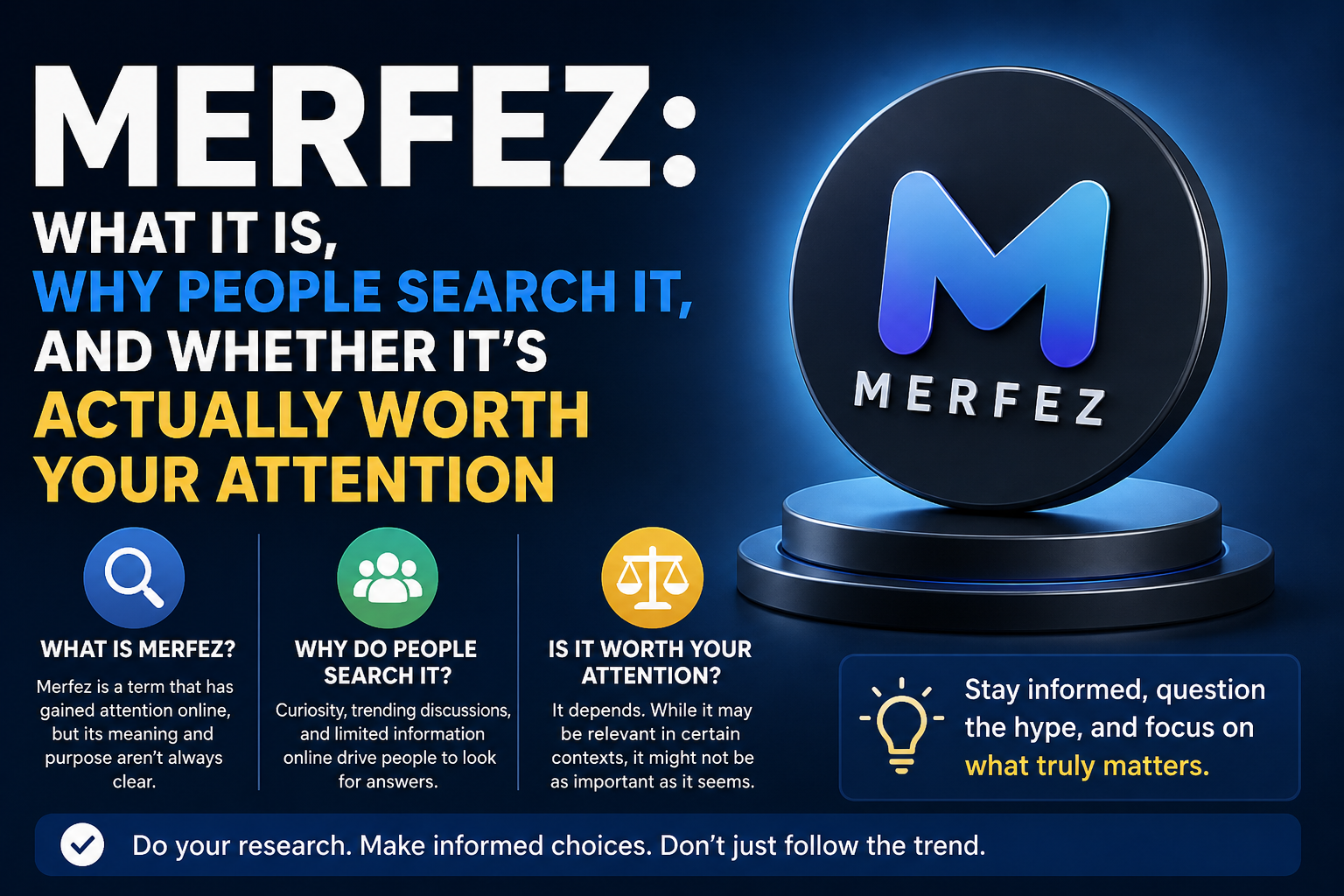
Most people do not search merfez because they care about the word itself. They search it because they ran into it somewhere online and need quick clarity.
That is the real intent behind this keyword.
In most cases, merfez shows up as a name attached to something else—a website, tool, listing, page, product mention, or digital reference. People search it because they want to answer a practical question fast: what is this, and is it worth my time?
That is the right way to approach it.
Merfez is not the kind of term that carries much meaning on its own. Its value depends almost entirely on where you found it and what it is connected to.
The Real Problem
Most pages about terms like merfez are not actually written for the person searching them.
They are written around the keyword, not the real question behind it.
That is why so many of them feel vague. They try to define the term as if it has one stable meaning, then pad the page with generic explanation. That sounds useful on the surface, but it usually leaves the reader with the same question they started with.
The real issue is simpler.
People do not search merfez because they want a formal definition. They search it because something about it was unclear enough to interrupt them.
Usually that means one of three things:
- they saw it on a site and want to know if the site is credible
- they found it in search and want to know if it matters
- they saw it attached to a product, tool, or listing and want to know if it is real
That is the actual problem users are trying to solve.
And once you look at it that way, merfez becomes much easier to understand.
What Merfez Usually Is
Merfez is best treated as a context-first internet term.
That means the word itself is not the useful part. The useful part is what the word is attached to.
This is common online. A term gets indexed, repeated, or attached to a digital asset before it develops any clear public identity. People start seeing it. They search it. Visibility grows faster than understanding.
That is likely what is happening here.
Merfez does not behave like a well-established public term with one accepted meaning. It behaves more like a digital label—something used online as a name, identifier, or brand-style reference that only makes sense in context.
That context is what tells you whether it matters.
Without context, merfez is just a searchable label.
With context, it may be:
- a site name
- a tool
- a niche service
- a low-visibility brand
- a product label
- a placeholder identity
- or simply something indexed before it was properly explained
That distinction matters more than the word itself.
Why People Search Terms Like This
This is where most articles stay too shallow.
People do not usually search obscure terms because they are researching them in depth. They search because they hit a small moment of friction.
Something feels unclear.
Something looks unfamiliar.
Something seems important enough to verify.
That is the trigger.
Merfez is the kind of word that creates that friction. It looks intentional. It feels like it should mean something. It is specific enough to seem important, but unclear enough to force a second search.
That is why people look it up.
Not because the word is inherently valuable.
Because uncertainty creates curiosity.
That is a much more honest explanation than pretending every searchable term has real standalone significance.
Real Examples / Use Cases
The easiest way to make sense of merfez is to look at the situations where people actually encounter it.
You saw merfez on a website
This is the most common case.
If merfez appeared in a site name, footer, menu, login page, or tool section, stop trying to define the word and start evaluating the site.
That will tell you more than any definition page.
Look for:
- clear ownership
- real contact information
- updated pages
- working navigation
- specific content
- signs of actual maintenance
- real purpose beyond branding
A vague name is not a problem.
A vague website is.
That is the difference that matters.
You saw merfez in search
This usually means one of two things.
Either the term has been indexed enough to surface in search, or enough people have searched it out of curiosity to make it visible.
Neither tells you much by itself.
Search visibility is not proof of quality. It is only proof that the term exists in searchable form.
That is useful to know, but not enough to trust it.
You saw merfez tied to a product or tool
This is where people should slow down.
A polished name can make almost anything look legitimate for a few seconds. That is often enough to create false trust.
If merfez is attached to software, a service, a tool, or a product, ignore the branding and inspect the function.
Ask:
- what does it actually do?
- who is behind it?
- does it solve a real problem?
- is there proof real people use it?
- does anything credible mention it?
That is the practical filter most users skip.
Common Mistakes
Assuming search visibility means legitimacy
It does not.
A term can be searchable and still be unimportant, low-quality, or misleading.
People confuse visibility with credibility all the time online.
They are not the same thing.
Spending too much time trying to define the word
This is usually wasted effort.
With terms like merfez, the word itself often matters less than the system, page, tool, or service using it.
Context answers more than definition does.
Trusting presentation too quickly
This is one of the easiest mistakes to make.
A clean interface, modern branding, and a polished name can create instant false confidence.
That is not proof of value.
It is presentation.
Always separate appearance from usefulness.
Comparison / Better Alternative
Merfez fits into a familiar category online: searchable terms with weak standalone meaning.
Some of these turn into useful niche tools or small but legitimate digital brands.
Many do not.
That is why the safest approach is not to assume merfez is meaningless—but also not to assume it is valuable just because it exists.
Treat it like an unknown digital label until context proves otherwise.
That is the most practical middle ground.
Actionable Solution
If you found merfez and want the fastest useful answer, do this:
- Go back to where you saw it
- Ignore the name for a moment
- Look at what it is attached to
- Check whether the thing behind it is credible
- Decide based on usefulness, not presentation
That will give you a better answer than most search results will.
FAQ
Is merfez a real thing?
Yes, in the sense that it exists online and people search it. That does not automatically make it useful or important.
Is merfez a brand?
Possibly. It has the structure of a brand-style digital name, but that alone does not tell you much.
Is merfez useful?
Only if the thing attached to it is useful.
Is merfez worth trusting?
Not by default. Trust should come from what it does, who runs it, and whether it shows real credibility.
Why are people searching merfez?
Usually because they saw it somewhere, lacked context, and wanted a quick reality check.
Final Verdict
Merfez is not the kind of term most people search because they are deeply interested in the word itself.
They search it because they came across it, lacked context, and wanted to know whether it meant anything useful.
That is the real story behind the keyword.
Merfez is best treated as a context-dependent digital label, not a self-contained idea. The name alone tells you very little. What matters is what sits behind it.


Leave a Reply