
Quick Answer
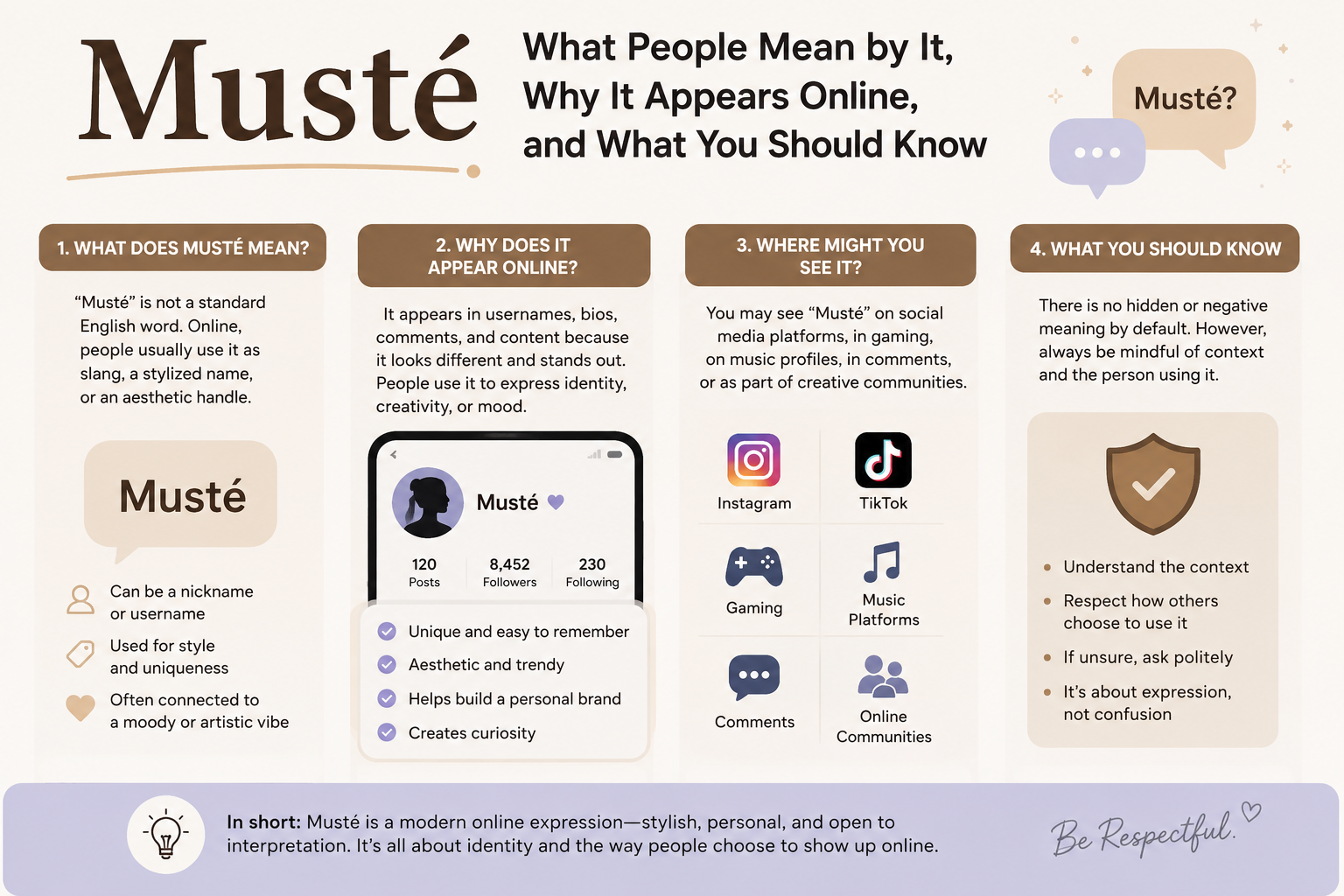
The word “musté” does not have one universally accepted meaning. In most online searches, people encounter it in one of three ways:
- as a stylized word or username,
- as a misspelling or accented variation of another term,
- or as a niche cultural, artistic, or branding reference.
Because the keyword is unclear and context-dependent, many users search “musté” simply trying to figure out whether it is a real word, a brand, a person, or internet slang.
The important thing to know is this: the meaning usually depends entirely on where you saw it.
The Real Problem
Most articles about unusual keywords make the same mistake: they immediately pretend the word has a fixed dictionary definition even when it clearly does not.
That creates confusion instead of helping the reader.
If you searched “musté,” chances are you encountered it somewhere specific:
- a social media profile,
- a fashion or beauty reference,
- a username,
- a caption,
- a product label,
- a music-related term,
- or an auto-correct variation.
The real challenge is not just defining the word. It is understanding the context behind it.
And that is where most generic content fails.
What Does “Musté” Usually Refer To?
A Stylized Name or Brand Identity
One of the most common modern uses of words like “musté” is branding.
Adding an accent mark often makes a simple word feel:
- more premium,
- artistic,
- fashion-oriented,
- European-inspired,
- or luxury-themed.
This happens constantly online.
For example, creators and small brands frequently modify ordinary words using accents to make usernames stand out visually. “Musté” fits that pattern perfectly.
In practice, that means the word may not have a traditional meaning at all. It may simply be a design choice.
Why people do this
Online branding is crowded. A regular word may already be taken as a username or domain.
Adding an accent:
- changes the appearance,
- creates a more memorable identity,
- and sometimes makes the name look more elegant or modern.
This is especially common in:
- fashion brands,
- beauty products,
- music projects,
- cafés,
- perfumes,
- boutique stores,
- and social media identities.
A Misspelling or Typing Variation
Another common possibility is that “musté” is accidental.
Accent marks often appear because:
- mobile keyboards auto-correct text,
- multilingual keyboards switch language settings,
- users intentionally stylize words,
- or copied text changes formatting.
Some people may have intended to type:
- “must,”
- “muse,”
- “muster,”
- or a French-inspired variation.
This matters because search engines now index stylized spellings very aggressively. Even accidental variations can become searchable keywords.
A French-Looking or European-Inspired Term
Many users assume “musté” is French because of the accent.
That assumption is understandable, but it can also be misleading.
Words ending in “é” often look French-inspired even when they are not authentic French vocabulary.
This creates an interesting online trend:
people associate accented words with sophistication, luxury, creativity, or culture — even when the word itself has no formal linguistic meaning.
That is why terms like “musté” can spread quickly in branding and online aesthetics.
Why Are People Searching for “Musté”?
Curiosity After Seeing It Online
This is probably the biggest reason.
Users often search unfamiliar words immediately after seeing them in:
- TikTok bios,
- Instagram handles,
- YouTube names,
- online stores,
- product packaging,
- or Pinterest posts.
The search intent is usually:
“What exactly does this mean?”
Not:
“Give me a dictionary definition.”
That distinction matters.
Trying to Verify Legitimacy
People also search unusual words to check whether something is trustworthy.
For example:
- Is it a real brand?
- Is it fake luxury marketing?
- Is it a scam store?
- Is it a legitimate creator?
- Is the word culturally meaningful?
This type of search behavior has become more common because many online brands now use abstract or invented names.
Looking for Pronunciation
Another overlooked reason people search words like “musté” is pronunciation confusion.
Most readers are unsure whether it should sound like:
- “mus-tay,”
- “moo-stay,”
- or “must.”
Accented spellings naturally create uncertainty, especially for English-speaking users.
Real Examples of How Similar Words Are Used Online
To understand “musté,” it helps to look at how modern internet naming works.
Example 1: Boutique Fashion Naming
Small fashion brands often create names that:
- sound elegant,
- look European,
- and feel visually unique.
The actual dictionary meaning becomes less important than the emotional impression.
That is why names with accents perform well aesthetically.
Example 2: Music and Artist Branding
Artists frequently stylize names using symbols or accents because:
- it improves memorability,
- changes search visibility,
- and creates a distinct identity.
In many cases, the word itself is invented.
Example 3: Social Media Username Culture
Platforms like TikTok and Instagram have normalized stylized spellings.
Users now intentionally modify words through:
- accents,
- missing vowels,
- repeated letters,
- or unusual typography.
“Musté” strongly resembles that pattern.
What Most Articles Miss About Keywords Like “Musté”
Many low-quality pages treat every keyword as if it has a deep historical meaning.
But internet language does not work that way anymore.
Modern searchable words are often:
- aesthetic,
- algorithm-driven,
- brand-created,
- or socially invented.
That changes how readers should interpret them.
A useful explanation is not always:
“Here is the dictionary definition.”
Sometimes the real value is explaining:
- where the term likely came from,
- why it looks the way it does,
- and how people actually use it online.
Common Mistakes People Make
Assuming It Must Have a Formal Definition
Not every searchable term comes from a dictionary.
Some are:
- usernames,
- brand inventions,
- stylized spellings,
- or internet-created language.
Trying to force a rigid meaning onto them often creates misinformation.
Trusting Random Auto-Generated Definitions
Many websites invent explanations for unclear keywords simply to rank in search results.
That can lead to:
- fake translations,
- incorrect language origins,
- or made-up historical claims.
If a source cannot explain where the term is actually being used, treat the definition carefully.
Ignoring Context
Context changes everything.
The meaning of “musté” could differ depending on whether you saw it in:
- fashion,
- music,
- beauty,
- social media,
- or online retail.
Always look at the surrounding content before assuming what the word means.
Is “Musté” a Real Word?
Possibly — but not necessarily in the way many people expect.
There are three realistic possibilities:
| Possibility | Likelihood |
|---|---|
| Stylized internet term | Very high |
| Brand or username | High |
| Formal dictionary word | Lower without context |
That does not make the term fake. It simply means its meaning is contextual rather than universal.
How to Figure Out What “Musté” Means in Your Situation
Check Where You Found It
Ask:
- Was it on social media?
- Was it attached to a product?
- Was it a person’s name?
- Was it part of branding?
The source usually explains the intent.
Look for Related Terms
Search nearby words, hashtags, or descriptions.
For example:
- fashion-related context,
- beauty products,
- music references,
- or creator profiles.
These clues matter more than the word alone.
Avoid Overcomplicating It
Sometimes unusual online words are simply aesthetic choices.
There may not be a hidden deeper meaning.
That is increasingly normal on today’s internet.
Better Alternatives If You Were Searching for Something Specific
Sometimes users searching “musté” actually meant:
- “must-have,”
- “muse,”
- “musté perfume,”
- “muste,”
- or another related term.
If your search results feel unrelated or confusing:
- remove the accent,
- try alternative spellings,
- or search the full phrase where you originally saw it.
This usually produces much better results.
FAQ
How do you pronounce “musté”?
Most people would likely pronounce it as:
“mus-tay”
But pronunciation can vary depending on branding or language style.
Is “musté” French?
Not necessarily.
The accent makes it look French-inspired, but that does not automatically make it a genuine French word.
Why do brands use accented words?
Because they:
- look distinctive,
- feel premium,
- and stand out visually online.
It is a common branding strategy.
Is “musté” internet slang?
It could be, depending on context. In many cases, stylized words become informal online identity terms rather than traditional vocabulary.
Why is “musté” hard to define?
Because it appears to be context-based rather than universally standardized.
Different users may use it differently.
Final Verdict
“Musté” is one of those modern internet-era terms that sits somewhere between branding, aesthetics, stylized language, and online identity.
For most users, the search is less about vocabulary and more about understanding context:
- What is this?
- Why does it look familiar?
- Is it a brand, a username, or a real word?
The most practical answer is that “musté” is likely a stylized or contextual term rather than a widely recognized standalone definition.
And that is exactly why people keep searching for it.



Leave a Reply